
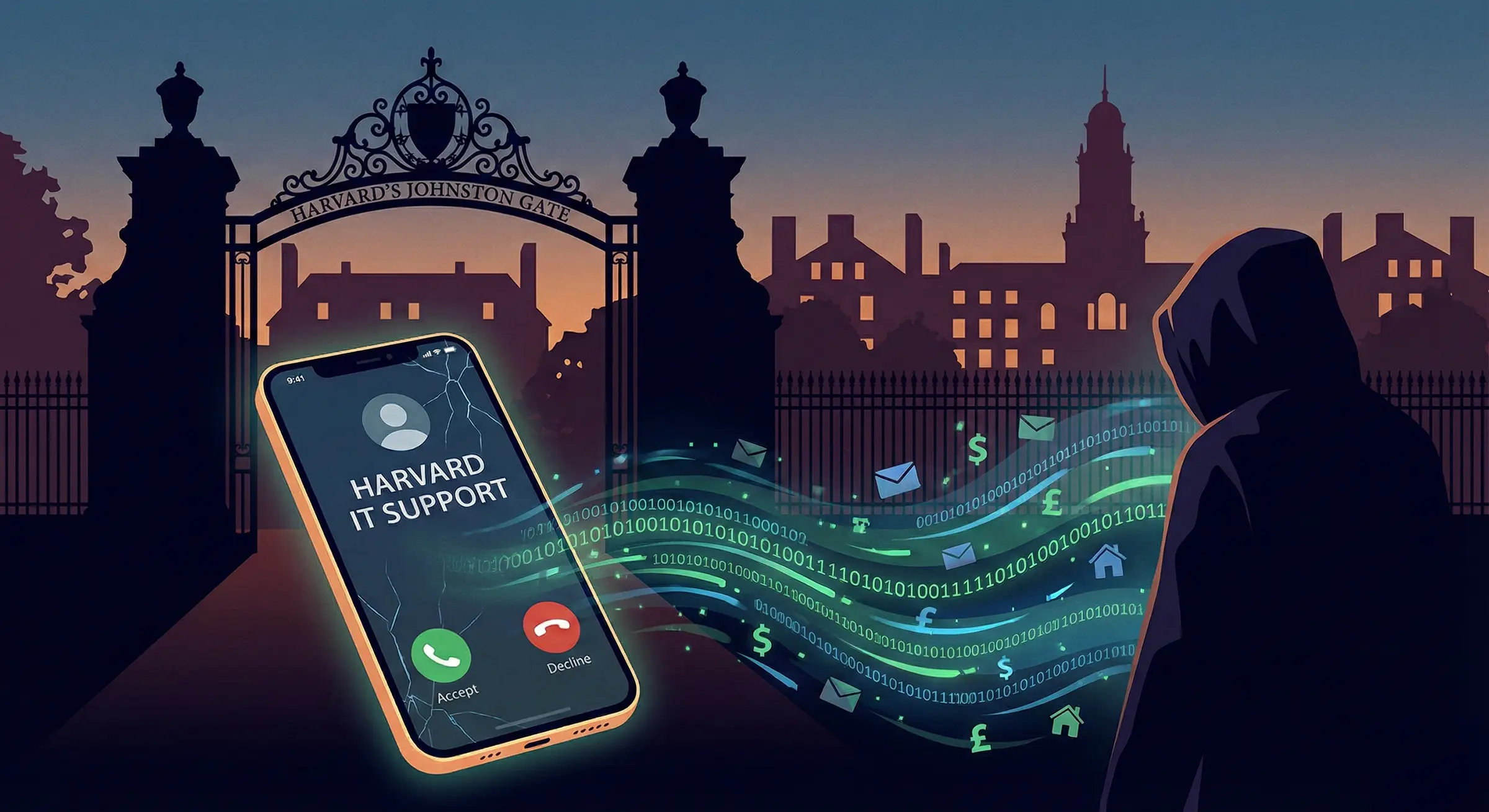
Harvard vishing breach: what actually happened
When news of the Harvard vishing breach broke, a lot of people had the same reaction: if Harvard can get tricked over the phone, what chance do the rest of us have?
According to Harvard, an attacker used a phone-based phishing call, also known as vishing, to gain access to information systems used by Alumni Affairs and Development. Once in, they could view data about alumni, donors, current and former students, faculty, staff and even relatives such as spouses and parents.
What systems were hit and whose data is involved?
On 18 November 2025, Harvard discovered that an unauthorised party had accessed systems used by its Alumni Affairs and Development office after a successful vishing attack on a university employee.
Those systems support fundraising and alumni engagement, so they naturally hold rich contact and relationship data, including:
- Names
- Email addresses and phone numbers
- Home and business addresses
- Donation history and pledge details
- Event attendance records
- Biographical notes used for fundraising and engagement
Harvard’s own incident FAQ confirms this picture and frames the incident as a phone-based phishing attack against staff.
What information did attackers see?
There is some good news. Harvard says the affected systems did not store:
- Social Security numbers
- Passwords
- Payment card data
- Bank account information
That means attackers probably do not have direct access to card numbers or online banking logins from this breach alone.
The bad news is that the exposed information is more than enough for highly targeted social engineering, such as:
- Fake donation requests that reference real past gifts
- Spear phishing emails pretending to be from Harvard staff, quoting real events you attended
- Fraudulent “verification” calls to update donor details, now armed with convincing background info
In other words, this breach creates a map of human relationships and money flows, which can be even more powerful than a stolen password.
What is vishing and why phone calls are now high-risk
How a vishing attack plays out step by step
Vishing is simply voice phishing. Instead of a fake email with a malicious link, you get a phone call from someone who sounds legitimate and confident. A typical vishing playbook looks like this:
- Pretext
The caller claims to be from IT support, HR, a bank, or a trusted partner. In a university setting, it might be “central IT” or “the security team”. - Urgency
They create pressure: “We have to verify your account now or you’ll lose access”, or “We detected suspicious activity and need to reset your login”. - Hook
They ask the victim to:- Read out a one-time code, or
- Approve a push notification, or
- Log into a “temporary security portal” that is actually a phishing site
- Account takeover
Once they capture credentials or session tokens, the attackers log in as the staff member and start exploring internal systems. - Quiet data harvesting
Instead of smashing and grabbing, they often browse and export data quietly, hoping to stay undetected long enough to copy donor lists, internal reports or financial details.
In the Harvard vishing breach, that process ended with attackers inside Alumni Affairs and Development systems, where they could see alumni and donor records.
Why phone calls often beat email filters
Most organisations now have decent email filtering. Suspicious domains, dodgy attachments and bulk phishing campaigns are more likely to be blocked or flagged. Phone calls live outside those defences.
Phone calls still work so well for attackers because:
- Staff feel social pressure to be polite and helpful on the phone.
- Caller ID can be spoofed to show a trusted number.
- Many helpdesks still rely on weak phone-based verification, such as name and job title.
- People see voice as more “real” and assume it is safer than email.
The Harvard incident is a textbook example of why that assumption is now outdated.
Ivy League data breach trend: Harvard, Princeton and Penn
Harvard is not alone. Over just a few weeks, multiple Ivy League institutions have reported serious incidents affecting alumni and donor data.
Princeton’s advancement database breach
On 10 November 2025, Princeton University confirmed that a database managed by its Advancement office, containing information about alumni, donors, some faculty, students and parents, was accessed by external attackers.
Princeton’s FAQ notes that attackers compromised a system used by Advancement, again putting relationship and donor records in the spotlight rather than classroom data.
The University of Pennsylvania donor leak
The University of Pennsylvania has also dealt with a major breach in 2025. According to public reporting, an attacker claimed access to internal systems and donor records, with sample data including names, addresses, email addresses, phone numbers, donation histories and even religious affiliations.
One report suggests that the attacker may have accessed over a million records and specifically targeted ultra-high-net-worth donors, planning to sell the dataset before releasing it more widely.
Why universities and donors are such attractive targets
Looking at Harvard, Princeton and Penn together, a pattern emerges:
- Wealthy donor bases
Top universities have deep-pocketed alumni and donors, which are highly valuable targets for fraud and extortion. - Complex legacy systems
Advancement and alumni systems often sit on older platforms that integrate with new tools, which creates tricky security gaps. - Trusted brands
People are less sceptical when someone says “I’m calling from Harvard” than when they claim to be from a random company. - Rich context data
Event attendance, donation history and personal notes help attackers craft very convincing stories in follow-up scams.
Together, these factors create a goldmine for social engineers.
What the Harvard vishing breach means for you
If you are an alum, donor or parent
If you have any connection to Harvard, Princeton or Penn and you have donated, signed up for events or kept in touch with alumni offices, you should assume that:
- Your basic contact details may already be in criminal hands.
- Attackers might know which university you support and may know roughly how often you donate.
- Future emails, texts or calls that reference real events or donations are not automatically genuine.
That does not mean panic. It means shifting your mindset. Rather than asking “does this sound like Harvard?”, ask:
“How am I verifying this person really is who they say they are?”
Red flags to spot in a vishing call
Here are practical signs that a call about your university account or donation might be a vishing attempt:
- The caller asks you to read out a code sent to your phone or email.
- They want you to log in while on the call and then report back a code or prompt.
- They push you to change payment details or set up a new direct debit without written confirmation.
- They refuse to let you call back via the official switchboard or listed contact numbers.
- They get annoyed when you ask to verify their identity or to receive the request in writing first.
The simplest defence: hang up, find an official number from the university’s website, and call back. Do not rely on numbers the caller gives you.
Simple habits that cut your risk
You do not need to become a security expert. A few habits go a long way:
- Treat every unexpected call about money or access as suspicious, even if it sounds routine.
- Never share one-time codes, MFA prompts or passwords with anyone, including “IT” or “security”.
- Ask the caller for a case reference and say you will call back using the number from the university’s official site.
- Keep an eye on your inbox for fake donation receipts or urgent “update your card” requests.
If something feels off, trust that instinct.
What organisations can learn from the Harvard vishing breach
Lock down helpdesks and call centres
The Harvard vishing breach highlights how powerful a single compromised staff account can be. Organisations should:
- Use strong caller verification before making changes or resetting access over the phone.
- Remove or restrict workflows that allow full account resets based only on knowledge-based questions.
- Ensure access to systems like alumni CRMs or donor databases uses multi-factor authentication and conditional access.
Train staff for “voice zero trust”
Security training often focuses on email examples. Call centres, alumni relations staff and finance teams also need role-specific vishing training, such as:
- Scripts that make it easy to say no when a caller pushes for shortcuts.
- Drills that practice handling suspicious calls and escalating them.
- Clear rules like: “We never ask you to read a one-time code over the phone.”
The goal is to treat voice channels with the same scepticism as untrusted email.
Reduce the blast radius when an account falls
No matter how good your defences are, someone will eventually be tricked. Resilience comes from limiting what happens next:
- Apply least-privilege access so that one compromised account cannot see every record.
- Keep detailed audit logs of what accounts access and export.
- Use automated alerts for unusual downloads or queries, such as large data exports from alumni or donor systems.
Harvard’s response, including cutting off access, working with law enforcement and notifying affected individuals, shows that incident response planning still matters once prevention fails.
Final thoughts: vishing will not stay an Ivy League problem
The Harvard vishing breach is a wake-up call, not an isolated oddity. Princeton and Penn are dealing with similar pain, and less famous institutions are likely facing the same attacks without the headlines.
The core lesson is simple:
Phone calls are now just another potentially hostile digital channel.
If you adjust your habits, question “urgent” calls about money or access, and insist on verifying callers through official channels, you dramatically cut your risk, whether you donate to Harvard or to a small local charity.