
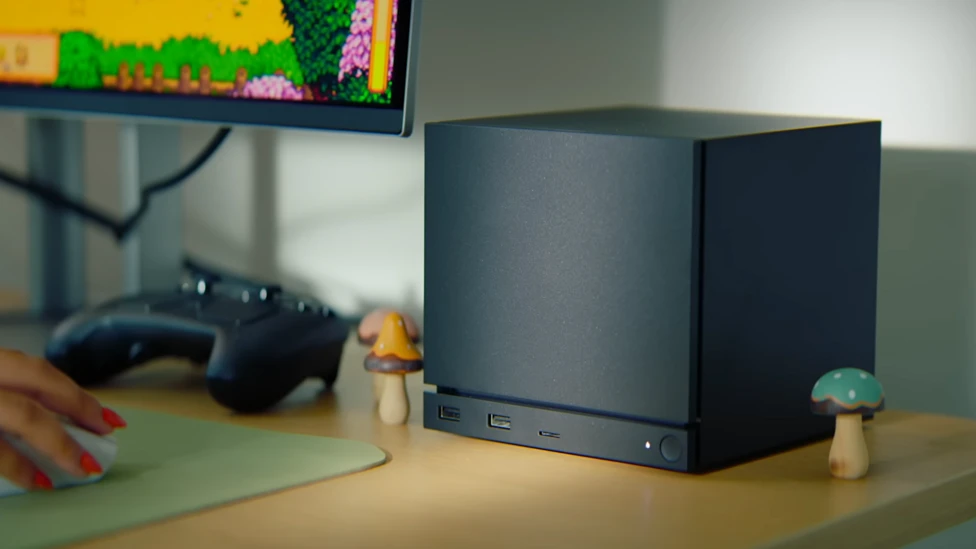
A Big Return to the Living Room
After years focusing on handhelds and PCs, Valve Corporation is making a bold comeback with the all-new Steam Machine — a compact, powerful console-style device designed for your TV setup and built to bring your entire Steam library into the living room.
What It Is
- The Steam Machine is not a generic mini-PC by partners, but an in-house product by Valve with fixed and clearly specified hardware—unlike the original Steam Machines experiment.
- It runs on SteamOS (Valve’s Linux-based OS) and supports Proton (compatibility layer) so many Windows titles will be playable.
- Shipping is expected in early 2026 in all regions where the Steam Deck is currently sold.
Key Specs
Here’s a rundown of the notable hardware, as reported:
- Custom AMD setup: a 6-core Zen 4 CPU (up to ~4.8GHz) paired with a semi-custom RDNA 3 GPU featuring ~28 compute units and 8 GB GDDR6 VRAM.
- 16 GB DDR5 system RAM.
- Storage choices: either 512 GB or 2 TB NVMe SSD, with microSD card slot for expansion.
- Outputs and connectivity: DisplayPort 1.4, HDMI (various reports mention up to 4K / 120 Hz), WiFi 6E, Bluetooth 5.3, and a dedicated 2.4 GHz wireless adapter for the Valve controller.
- Valve claims the device delivers up to “six times the performance” of the Steam Deck, targeting smooth 4K – 60fps gaming via upscaling like AMD’s FSR.
Design & Experience
- The machine’s size and shape aim to fit comfortably into a TV-cabin setup — cube-like and compact.
- Swappable front panels allow customization of the look (e.g., themed bezels or e-paper displays).
- Valve emphasises quiet cooling, dense heatsink structure, and minimal wasted internal space — appropriate for living-room use.
What About Price & Release Date?
- Release is slated for early 2026.
- Price has not yet been formally announced. Valve says pricing will be “comparable to a PC with similar specs” and “competitive with what you could build yourself”.
Strengths & Potential Weak Spots
What stands out
- A strong proposition for gamers who have built up large libraries on Steam and want a streamlined living-room experience.
- Hardware appears well-balanced for modern gaming and for stepping beyond typical console performance.
- Valve’s direct control over the hardware means better optimisation of SteamOS and driver support.
What to watch
- While the specs sound promising, there are trade-offs: eg. 8 GB VRAM may raise questions for future titles targeting ultra settings or native 4K. Indeed, some articles caution not to assume “everything will run at 4K/60 fps ultra settings”.
- Upgrade path appears limited: out of the box only storage (and maybe RAM) seems upgradable. CPU/GPU likely fixed.
- Valve’s previous Steam Machines (from 2015) didn’t succeed; the company knows this and appears to have learned lessons.
Verdict
The new Steam Machine represents Valve’s second attempt to bring PC-gaming into the living-room console form-factor — this time with stronger hardware, tighter integration, and lessons learned from earlier missteps. If it delivers on its promise of console-simplicity plus PC-power, it could be a compelling option for gamers who don’t want to fuss with full desktops or gaming laptops. That said, buying early always carries some risk: how many titles will fully support this hardware, how will performance hold up long-term, and what will the final price be?